
Providing Life Skills for Young Adults and Teens
Transitional Skills Program
The Transitional Skills Program focuses on developing life skills for young adults and teens. Participants with different disabilities — ages 14-22 — gain the tools they need to reach their goals, whether that’s:
- Competitive, Integrated Employment
- Post-secondary Education
- Independent Living
Building the Skills Participants Need to Reach Their Life Goals in the Greater Community
The TSC program offers two sessions: morning (8 a.m. to 11:30 a.m.) and afternoon (12 p.m. to 3 p.m.).
During their sessions, participants with disabilities develop the skills and behavior that lead
to success. Participants gain the confidence they need to improve and empower their future.
A Comprehensive, Interdisciplinary Curriculum
We use a research-backed curriculum that addresses real-world challenges and goals. Our comprehensive, interdisciplinary curriculum covers three domains. Each domain has various competencies and sub-competencies in addition to learning modules.

Flexible Lessons to Meet Unique Needs and Goals
We provide lessons at three levels of increasing complexity. This approach allows participants to continue growing and refining their independent living skills. From daily living and interpersonal relationships to employment, participants can master the skills they need to live their best lives.

Engaging Activities That Offer Real-world Skill Practice
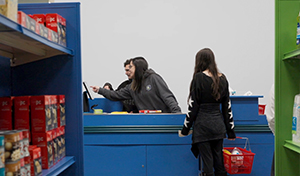
During the program, participants engage in daily living activities that involve both abstract and tangible concepts. A key part of our curriculum is community-based learning experiences. Our participants have the opportunity to go out into our community and practice the skills they’re developing.
A Comprehensive Program
Helping Young Adults Discover Their Potential
Group Facilitation
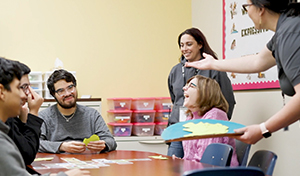
Facilitators help participants develop and grow their independent living skills by guiding participant-centered activities, discussions, and simulations that are customized to the interests and skill level of participants. Participants practice both individual focus and how to work with and as a group using soft and executive skills for more independent living or the workforce.
Community-Based Learning Experiences
After participants develop skills through practice in our state-of-the-art real-life simulations, they can practice them in the community. During our typical program — five days a week, three hours a day — participants are in the community with their peers up to 50% of the week, using their skills by working at local non-profit organizations and various small businesses. TSC partners with a wide variety of local businesses to provide in-depth, hands-on training that develops practical and interpersonal skills. These integrated employment opportunities provide participants with insight into career choices, empower participants to gain independence, increase teamwork and build confidence in a group environment. Participants are introduced to our community by visiting businesses and public offices to learn about the many jobs within each organization, as well as learning the value of service to the community through these experiences.

Nutrition and Independent Living
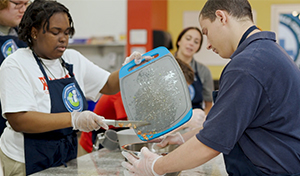
Participants explore gradual mastery of tools and ingredients in a hands-on state-of-the-art kitchen. From the functional math required for meal planning and shopping to cleaning, cooking, dining, and problem-solving, participants cultivate mindfulness and joy in the responsibility of managing a kitchen, home, or work space with real-world skill. It’s in the kitchen of TSC where participants also bake and create prepared goods for small-business simulation in the community.
Recreation and Wellness
With our recreation and wellness component, participants can participate in various sporting, team-building, and group-dynamic activities. These activities help participants enhance their fine motor ability, social interaction, and problem-solving skills. Our team promotes the importance of well-rounded and diverse styles of exercise, nutrition, and healthy lifestyles during each session. Participants learn how to follow and interpret directions with music, practice mindfulness, and improve their physical, social, and emotional well-being. With these skills, our participants can achieve their independent living goals and live a better quality of life.
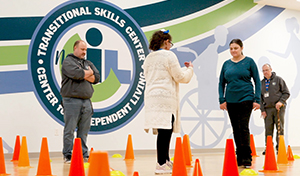
The students who are participating in the program cannot wait to go every day.
Art and Social Emotional Learning
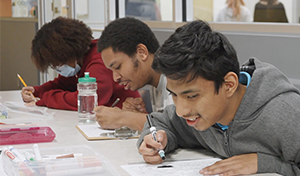
Our art and social emotional learning (SEL) component promotes communication, emotional regulation, and adaptation to a sensory-rich environment. Individual and group expressive arts and SEL activities are cathartic and beneficial for participants who struggle with verbal communication, are nonverbal, or who have anxiety regarding verbal communication. Our team creates a positive communal environment and opportunity for increased social participation, sense of belonging, and nonverbal bonding. We facilitate these valuable forms of expressive communication through visual, tactile, and written activities, all rooted in self-reflection.
Achieving Independent Living for Young Adults
Contact Us Today to Learn More
Contact us today at 570-207-9101 to learn how the Transitional Skills Center can help your student live their fullest life. Schedule your personal tour today to see firsthand how we’re teaching independent living for young adults in an immersive setting.
Call
Contact a Team Member
570-207-9101 ext. 20906
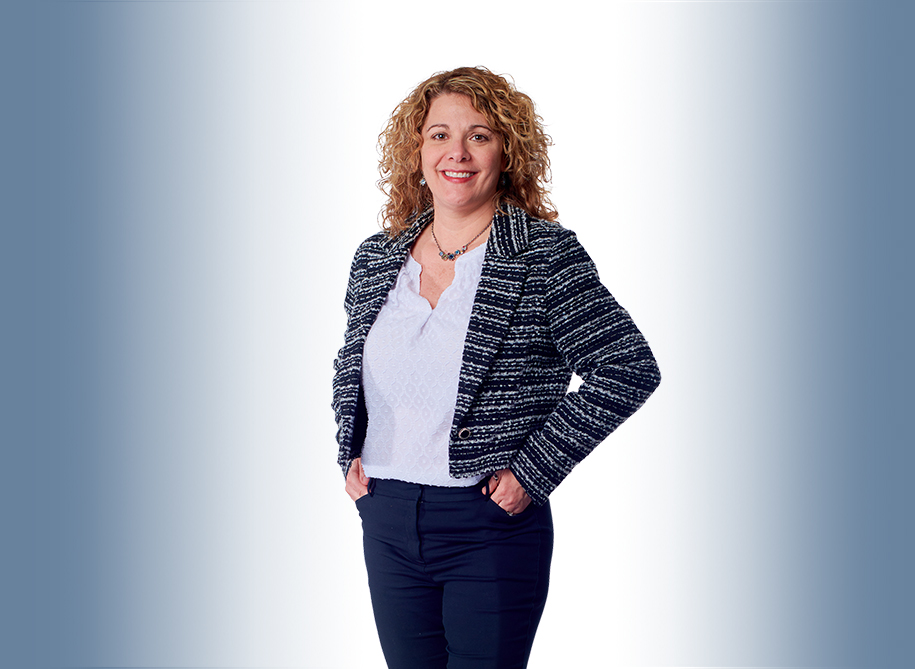
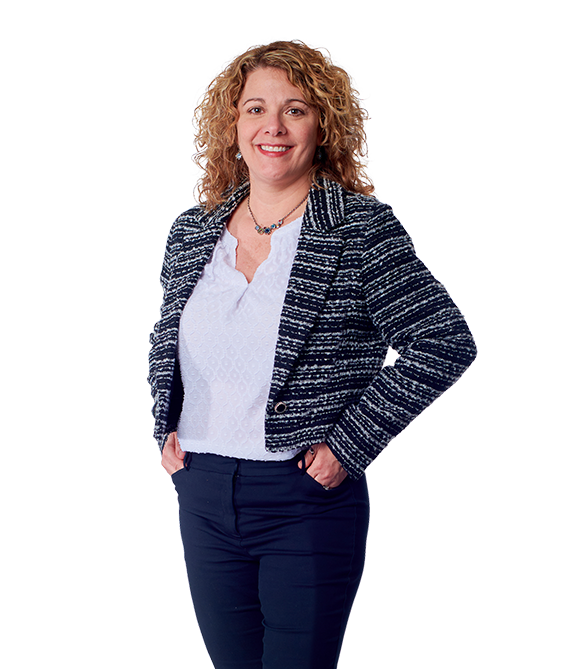
Sue Sileo
Director, Transitional Skills Center
ssileo@mycil.org
Scranton, PA
18509
Information About the Transitional Skills Center
Resources
Downloads
About the Transitional Skills Center
Program Overview Brochure
PDF
Program Overview Flyer
PDF
Program Overview Flyer (Español)
PDF
Program Overview Rackcard
PDF
Program Overview Rackcard (Español)
PDF
Student Testimonials Flyer
PDF
TSC Is Spreading Petals for Goodness Sake Flyer
PDF
TSC Is Spreading Petals for Goodness Sake Flyer (Español)
PDF
Welcome Packet
PDF

 ACES$ Online